 How long does commercial carpet cleaning take?


-
 Manu Sareen
 -
 17-07-2026
Hotel Cleaning Services in London: What to Expect From a ...
Walk into a hotel room that has not been cleaned properly and you know within seconds....
Read More

 17 June 2026, 04:45:00 BST
Post by: Manu Sareen
17 June 2026, 04:45:00 BST
Post by: Manu Sareen
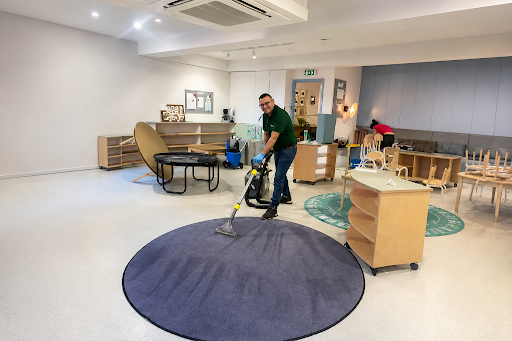
Walk into a competitor's office and the thing you notice before you notice anything else is the floor. Worn traffic lanes running from the lift to the reception desk. A grey haze over what was once a confident corporate blue. A faint smell of years of shoes and spilled coffee. Carpet tells the story of how a business looks after itself ;whether it intends to or not.
Most facilities managers and office managers know their carpets need professional cleaning. The question is always the same: how often, what method, and what should a proper commercial carpet cleaning service actually include? This guide answers all of that.
Commercial carpet cleaning is a professional cleaning service designed for carpets in business, retail, hospitality, healthcare, and education environments. It is fundamentally different from domestic cleaning in three ways.
Scale. Commercial carpets cover far greater floor area than residential ones. A single open-plan office floor might run to several hundred square metres. Professional equipment ;truck-mounted extraction units, rotary machines, industrial hot water extraction systems ;is required to clean at that scale efficiently.
Traffic load. An office carpet absorbs far more footfall than any home. Every visitor, member of staff, delivery operative, and maintenance engineer brings in dirt, grit, moisture, and bacteria. That grit cuts into carpet fibres with every step, accelerating wear in a way that simply vacuuming cannot address.
Hygiene standards. Commercial environments carry legal obligations around workplace hygiene under the Health and Safety at Work Act 1974 and the Workplace (Health, Safety and Welfare) Regulations 1992. Carpets trap allergens, dust mites, airborne pollutants, and bacteria deep within their fibres. Professional commercial carpet cleaning is not optional maintenance ;it is part of running a safe, compliant workplace.
The short answer: any business with carpeted flooring in a space that receives regular footfall.
That includes:
| Sector | Why carpet cleaning matters |
|---|---|
| Offices & corporate spaces | From small serviced offices to multi-floor headquarters |
| Retail stores & shopping centres | High-footfall, high-visibility — carpet condition affects customer perception directly |
| Hotels & hospitality venues | Bedrooms, corridors, conference suites, and lobbies carry specific hygiene expectations |
| Healthcare facilities | GP surgeries, dental practices, and private hospitals where infection control is a regulatory requirement |
| Educational institutions | Schools, colleges, and universities with heavy daily use from children and young adults |
| Leisure & entertainment venues | Cinemas, theatres, leisure centres, and gyms with diverse user groups |
If your business occupies any of these environments, a professional carpet cleaning schedule is not a luxury ;it is a baseline operational standard.
| What vacuuming removes | What vacuuming leaves behind |
|---|---|
| Surface dust and loose debris | Deeply embedded grit and particulates |
| Visible crumbs and litter | Bacteria, allergens, and dust mites |
| Some pet hair | Dried liquid stains and residues |
| Loose surface fibres | Ground-in soiling from foot traffic |
A commercial vacuum removes what sits on the surface. It does not reach the base of the carpet pile, where grit accumulates and acts like sandpaper against the fibres with every step. Over time, this embedded grit is the primary cause of premature carpet failure ;not wear from walking, but abrasion from trapped debris.
Beyond the structural damage, there is a hygiene argument. The Health and Safety Executive (HSE) recognises clean workplaces as critical to preventing the spread of contaminants that affect employee health and productivity. Carpets that are not professionally cleaned regularly harbour allergens that trigger respiratory issues, and bacteria that thrive in warm, humid fibres. Neither of those things is addressed by a daily vacuum.
A professional commercial carpet cleaning service follows a structured process. Here is what you should expect from start to finish.
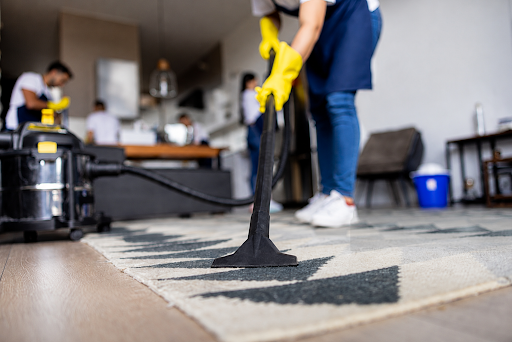
There is no single best method. The right technique depends on your carpet type, how soiled it is, how much drying time you can allow, and the operational constraints of your building. Here is a plain-language breakdown.
The industry benchmark for deep cleaning. High-pressure hot water is injected into the carpet pile along with a cleaning agent, then immediately extracted by a powerful vacuum together with dissolved soiling and bacteria. This method reaches deep into the fibre base, producing the most thorough clean available. It requires a longer drying time, typically four to eight hours, and is best suited to after-hours or weekend cleaning slots. Our steam cleaning service uses professional-grade hot water extraction equipment across all commercial carpet cleans.
A polymer-based cleaning agent is applied and worked into the carpet using a rotary or cylindrical brush machine. The product crystallises around soil particles as it dries, and the crystals are then vacuumed away. Drying time is very fast, often under an hour, making encapsulation ideal for offices that cannot close for a full day. It does not match the depth of HWE and is best used as a maintenance clean between deeper extraction cycles.
An absorbent pad is rotated across the carpet surface, picking up surface soiling. Fast and low-moisture, but limited in depth. Suitable for maintaining appearance in low-traffic areas between professional deep cleans, not appropriate as a standalone commercial cleaning method.
A dry or near-dry cleaning compound is spread across the carpet and worked in using a brush machine. The compound absorbs soiling and is then vacuumed away. Very low moisture and fast drying, which suits delicate natural fibre carpets or environments that cannot tolerate any wetting. Less effective on heavily soiled carpets.
|
Quick answer : Most commercial carpets need professional cleaning every 3 to 6 months. High-footfall areas may need interim cleaning every 6 to 8 weeks. A single annual clean is almost never sufficient. |
The right frequency for your business depends on five factors: footfall, type of use, carpet colour and fibre, sector-specific hygiene requirements, and manufacturer warranty terms. Here is a practical reference guide.
| Environment | Recommended Frequency | Notes |
|---|---|---|
| High-traffic entrances, corridors & receptions | Every 6–8 weeks (interim) + deep clean quarterly | Grit from outside does the most damage here; do not neglect these areas |
| Open-plan offices (medium traffic) | Every 3–6 months | Daily vacuuming buys time, but does not replace professional extraction |
| Meeting rooms and boardrooms | Every 6 months | Lower footfall but important for presentation; do not allow visible soiling |
| Retail floors | Every 3 months minimum | Customer perception is commercial reality; dirty carpets cost sales |
| Hotel bedrooms and corridors | Monthly or per-occupancy | Corridors particularly absorb trolley wheels, luggage, and heavy daily footfall |
| Healthcare and care settings | Monthly recommended | Infection control requirements demand higher frequency and documented records |
| Educational environments | Each holiday period | Aligns with natural operational shutdowns and manages term-time build-up |
| Leisure venues and cinemas | Monthly in public areas | Food, drink, and high footfall from diverse user groups create rapid soiling |
Do not wait for the calendar if any of the following happen:
Most commercial carpets need cleaning before they look like they need cleaning. By the time visible deterioration is obvious, damage to the fibres is already underway. Watch for these signals:
Facilities managers who defer carpet cleaning to save money typically spend more than they save. Here is the straightforward arithmetic.
Carpet replacement costs far more than cleaning: Quality commercial carpet for an office costs anywhere from £15 to £80 per square metre installed. Regular professional cleaning extends carpet life by several years. A 500 square metre floor professionally cleaned twice a year for five years costs a fraction of replacing it at year three because premature fibre degradation was allowed to take hold.
First impressions have commercial value: Research consistently links workspace cleanliness to client perception, employee retention, and productivity. The appearance of your carpet is not a cosmetic concern ;it is a business signal that clients and prospective employees read before a word is spoken.
Health and compliance carry legal weight: Under UK workplace regulations, employers have a duty to maintain a clean and hygienic working environment. Poor indoor air quality linked to neglected carpets contributes to staff illness and absence. A documented carpet cleaning programme is a straightforward part of responsible facilities management.
Warranty protection: Most commercial carpet manufacturers specify minimum cleaning frequencies as a condition of their warranty. Failing to follow these intervals can void the warranty, meaning that if a fault develops, you have no recourse.
Not all carpet cleaning providers operate to the same standard. Before you appoint anyone, ask these questions:
At Green Facilities, our commercial carpet cleaning is carried out by trained, vetted operatives using professional hot water extraction and encapsulation equipment. We use eco-responsible, COSHH-compliant chemistry aligned with our ISO 14001 environmental certification. Every clean comes with a written completion report. As a B Corp certified company, we also support clients who need to evidence sustainable supply chain choices for ESG reporting or procurement audits.
Carpets do not exist in isolation. The most effective approach to commercial floor care treats carpet cleaning as one layer of a broader programme.
In environments with mixed flooring ;carpet in office areas, hard flooring in reception, kitchen, or washroom spaces ;consider how your programmes interact:
If you are uncertain about the right combination of services for your building, our cleaning consultancy service can audit your current provision and produce a practical, costed recommendation.
This depends on the area, soiling level, and cleaning method. A 200 square metre office cleaned using hot water extraction typically takes two to four hours. Encapsulation on the same area might take under two hours. We always advise clients on expected duration before work begins.
With hot water extraction, carpets are typically walkable within four to eight hours, depending on ventilation and temperature. Encapsulation-cleaned carpets can often be walked on within the hour. We always advise minimum drying times and can schedule cleans to align with your operational windows.
Many stains that appear permanent can be significantly reduced or eliminated with the right chemistry and method. The key variable is time ;the longer a stain has been left untreated, the harder it is to remove. Pre-treatment before the main clean is always part of our process. Some stains from bleach, certain dyes, or chemical spills may have permanently altered the carpet fibre, in which case we will advise honestly rather than overstate what is achievable.
Carpet tiles are cleaned using the same methods as broadloom carpet. An advantage of tiles is that badly damaged or stained sections can often be replaced individually at lower cost than relaying an entire floor. We will identify any tiles during our inspection that are beyond restoration and advise accordingly.
Yes, with the right products. Modern enzyme-based and plant-derived cleaning agents perform at a level comparable to traditional chemical alternatives in most commercial scenarios. At Green Facilities, we use eco-responsible chemistry as standard ;because we believe you should not have to choose between a clean workplace and a responsible supply chain.
This depends on your lease terms. In most UK commercial leases, the tenant is responsible for maintaining the internal condition of the premises, which includes flooring. Some leases specify minimum cleaning standards and require evidence of professional cleaning at defined intervals. Check your lease before assuming ;and keep written records of every professional clean as documentation of compliance.
Green Facilities provides commercial carpet cleaning services across London and the surrounding areas. Our team works around your operational hours ;evenings, weekends, and out-of-hours slots ;to minimise disruption to your business.
Every clean comes with eco-responsible chemistry, professionally trained operatives, and a written completion report. We build cleaning programmes around your specific environment rather than selling blanket packages.
no obligation, no pressure, just a straight conversation about what your carpets need.
Get Your Free QuoteOur team is ready to assist you with any questions you may have. Please feel free to reach out with any questions or concerns, and we will get back to you as soon as possible.
 Manu Sareen
17-07-2026
Manu Sareen
17-07-2026Walk into a hotel room that has not been cleaned properly and you know within seconds....
Read More
.png) Manu Sareen
02-07-2026
Manu Sareen
02-07-2026"Eco-friendly” is one of the most overused words on a cleaning services label - and one...
Read More
Manu Sareen
17-06-2026Walk into a competitor's office and the thing you notice before you notice anything else...
Read More
 Manu Sareen
26-05-2026
Manu Sareen
26-05-2026Ask any Environmental Health Officer what keeps them up at night and they will tell you:...
Read More
 Manu Sareen
11-05-2026
Manu Sareen
11-05-2026We want to be upfront about something. When we first started exploring autonomous...
Read More
 Manu Sareen
22-04-2026
Manu Sareen
22-04-2026Most businesses spend thousands ensuring their reception looks immaculate and their...
Read More
 Manu Sareen
31-03-2026
Manu Sareen
31-03-2026Walk into a well-maintained office and you feel it immediately - fresh air, clear...
Read More
 Manu Sareen
20-03-2026
Manu Sareen
20-03-2026If you manage a commercial property, office building, hotel, or retail space in the UK,...
Read More
 Manu Sareen
27-02-2026
Manu Sareen
27-02-2026In an industry where trust, consistency, and accountability underpin every client...
Read More
 Manu Sareen
06-02-2026
Manu Sareen
06-02-2026When regular cleaning is no longer enough, deep cleaning services step in to restore...
Read More