

-
 Manu Sareen
 -
 18-09-2026
Poolside Area Cleaning and Maintenance for Hotels and ...
A swimming pool is one of the most valued amenities a hotel or health club can offer, and...
Read More

 26 May 2026, 14:37:14 BST
Post by: Manu Sareen
26 May 2026, 14:37:14 BST
Post by: Manu Sareen
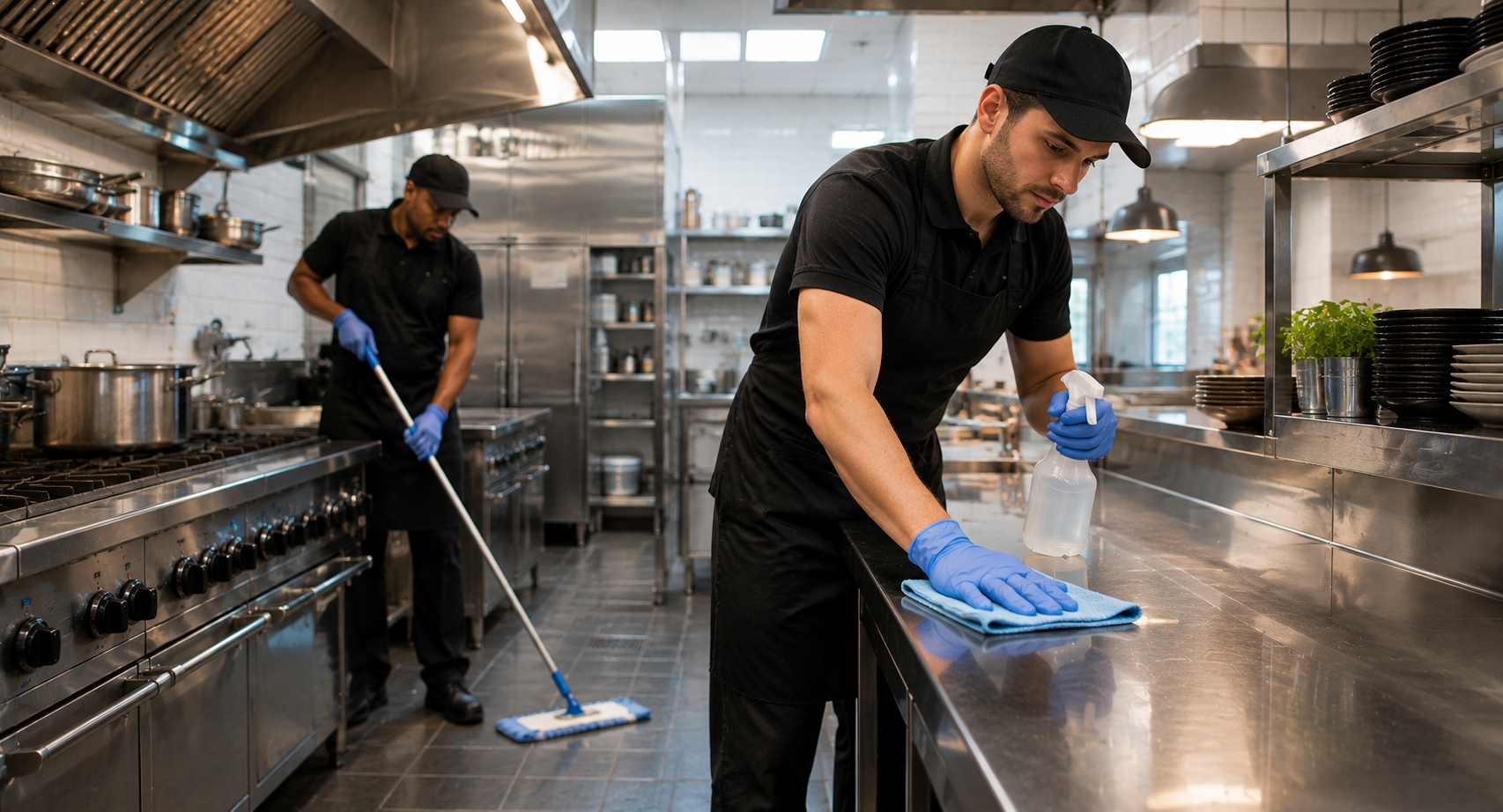
Ask any Environmental Health Officer what keeps them up at night and they will tell you: it is the commercial kitchens that think a quick wipe-down after service counts as cleaning. Professional kitchen deep cleaning services exist precisely because surface-level cleaning is never sufficient, and the consequences of neglecting them are always more expensive than the clean itself.
Whether you run a busy London restaurant, a hotel kitchen delivering 300 covers a night, or a workplace canteen, the standard of your kitchen hygiene affects your Food Standards Agency rating, your staff wellbeing, and your commercial reputation in equal measure. The recent surge in UK searches for kitchen deep cleaning services suggests businesses are finally taking this seriously. This guide covers everything you need: what a professional deep clean involves, how often you genuinely need one, what the law expects of you, and how to identify a cleaning partner worth trusting.
160,000+Food poisoning cases reported annually in the UK (Food Standards Agency)
|
£5,000+Typical FSA fine following a failed hygiene inspection
|
40%Of commercial kitchen fires are linked to grease build-up in extraction systems
|
A commercial kitchen deep cleaning service is a thorough, systematic clean that goes far beyond the maintenance your kitchen team carries out between shifts. It covers every surface, piece of equipment, and hard-to-reach corner of your kitchen, including areas that simply cannot be addressed during active food service.
Your nightly clean removes visible grime. A deep clean addresses the grease slowly baking onto your extraction canopy over months, the carbonised residue inside oven cavities, and the microbial build-up in the spaces behind and beneath refrigeration units. These are not cosmetic concerns. They are fire hazards and food safety risks that your daily routine will never resolve.
A reputable provider will always issue a written completion report after each visit, documenting the scope of work, the products used, and any areas of concern identified. This record is invaluable when your Environmental Health Officer arrives unannounced.
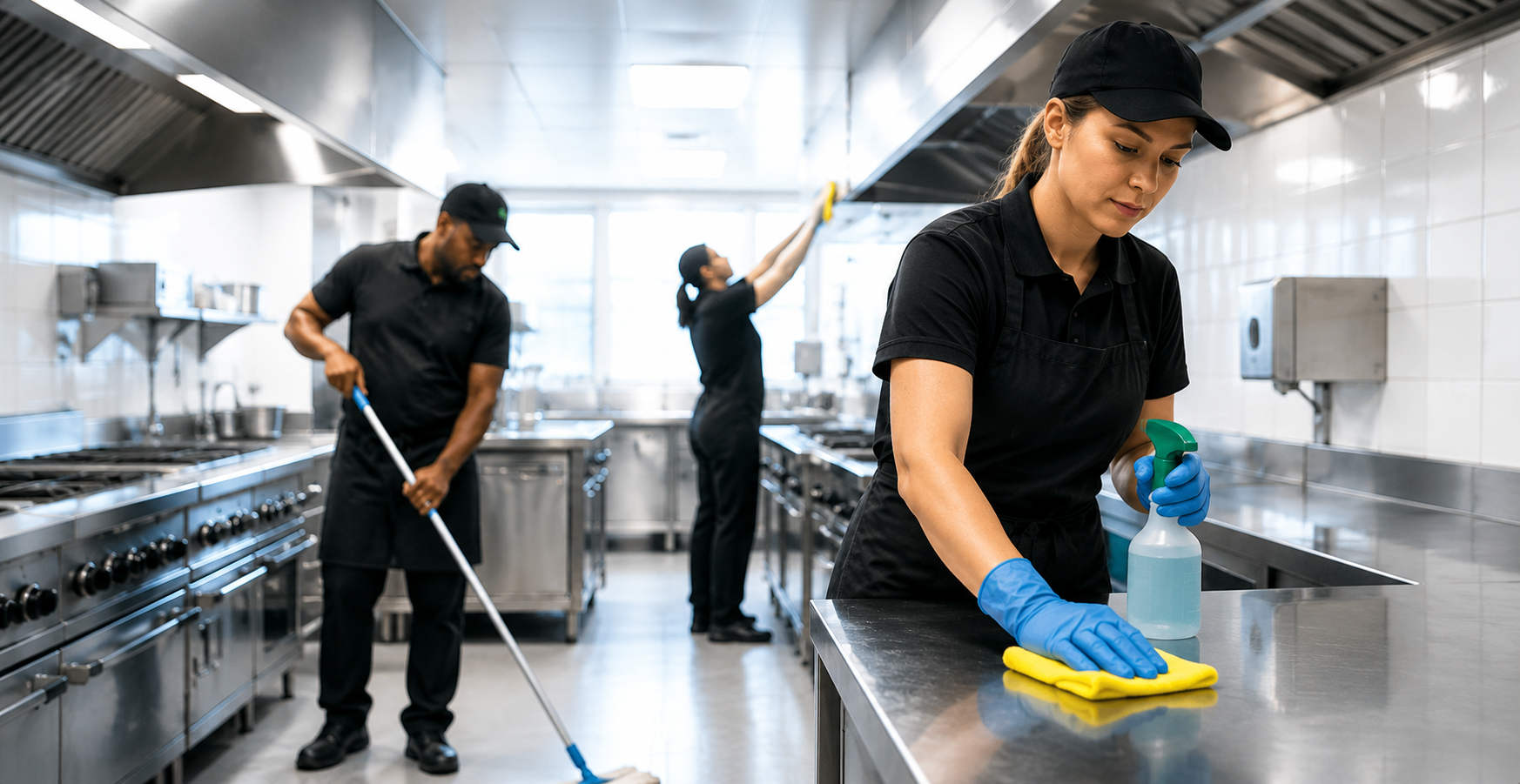
Grease accumulation on extraction systems is a leading cause of commercial kitchen fires across the UK
A common misconception among smaller hospitality businesses is that a thorough daily clean by kitchen staff is sufficient to maintain food safety standards. Here is why that belief gets businesses into trouble.
Grease accumulates invisibly. Every time you fire up a deep fat fryer or char-grill, airborne grease particles settle on your extraction canopy, ductwork, and surrounding surfaces. Over weeks and months this builds into a thick, highly flammable coating. The National Fire Chiefs Council consistently identifies inadequate extraction cleaning as a major contributor to commercial kitchen fires in the UK.
Bacteria colonise the places your team cannot reach. Door seal crevices, the undersides of prep surfaces, and the floor spaces beneath refrigeration units are where pathogens including E. coli, Listeria, and Salmonella thrive. Your kitchen team cannot move industrial equipment during a busy service. Professional deep cleaners can, and do, as a matter of routine.
Hygiene ratings matter commercially: Under the Food Hygiene Rating Scheme, Environmental Health Officers assess cleanliness, food safety management, and structural compliance. Poor deep-cleaning records are among the most frequent reasons businesses receive a rating of 2 or below. In today's market, that rating is publicly visible and commercially damaging.
The honest answer depends on how busy your kitchen is and what you cook. That said, there are broadly accepted industry benchmarks that your insurer and your local authority will expect you to follow.
| Kitchen Type | Recommended Frequency | Notes |
|---|---|---|
| High-volume restaurants and hotel kitchens | Monthly Minimum | Heavy frying operations may require fortnightly extraction cleaning |
| Pub kitchens and casual dining | Every 6 to 8 weeks | More frequent if your menu relies heavily on grilling or frying |
| Workplace cafes and canteens | Every 3 months | Lower throughput means slower grease build-up, but it still happens |
| Care homes and healthcare kitchens | Monthly Recommended | Serving a vulnerable population means zero tolerance for contamination |
| School and university catering | Each school holiday period | Natural calendar breaks align well with quarterly schedules |
Beyond scheduled deep cleans, you should consider an unscheduled clean following any pest incident, after a food safety complaint, if you receive a poor hygiene inspection result, or whenever your kitchen has been closed for more than a few weeks. Our team at Green Facilities kitchen cleaning builds bespoke schedules around each client's operation rather than applying blanket frequency rules.
Understanding the process helps you evaluate whether a provider is delivering genuine value or a very expensive wipe-down. A professional kitchen deep cleaning service should follow a structured sequence like this.
Before work begins, the team walks your kitchen to identify problem areas and confirm scope. Equipment is confirmed as cooled down, dry goods are moved clear, and the COSHH-compliant products planned for use are confirmed with your site contact.
Filters are removed, fan blades and grease traps are cleaned, and interior ductwork is degreased to TR19 compliance standards. This phase requires specialist equipment and professional-grade chemistry. It cannot be replicated with products available to the public.
Each piece of cooking equipment is systematically stripped down, soaked where possible, steam cleaned, and degreased. Special attention goes to the hidden internal surfaces of ovens, fryers, and grills where carbonised residue accumulates most aggressively. Our steam cleaning service is particularly effective here.
Tiles are scrubbed and descaled. Grout lines are sanitised. Floors are machine-scrubbed and treated. The wall panels behind cooking lines receive particular attention given the grease splash absorbed during service. See also our commercial hard floor cleaning service for ongoing floor maintenance between deep cleans.
Cold storage units are cleaned internally and externally. Condenser coils are checked for dust build-up that impairs energy efficiency. Floor drains are cleared, descaled, and treated with enzyme-based cleaners to prevent odour and blockages developing between visits.
Every food-contact surface is sanitised with an approved bactericide. The lead technician conducts a final walkthrough with a responsible person from your team, and a written completion report is issued, including any recommendations for follow-up attention.
This is a question we hear regularly, especially from businesses with sustainability commitments or ESG reporting obligations. The short answer is yes, with the right chemistry.
Modern green cleaning science has advanced significantly. Enzyme-based degreasers, plant-derived surfactants, and biodegradable descalers now match or outperform traditional petrochemical products in most commercial kitchen scenarios. The key is understanding which product is right for each surface and residue type, which is where professional expertise matters.
Our kitchen deep cleaning service uses products that are both highly effective and environmentally responsible. This commitment is reflected in our EcoVadis Bronze accreditation and our ISO 14001 environmental certification. You do not have to choose between a spotless kitchen and a responsible supply chain.
Procurement teams, investors, and large clients increasingly ask businesses to evidence sustainable supply chain choices. As a B Corp certified cleaning company, Green Facilities can provide the documentation your business needs to support its own sustainability claims. This matters particularly for businesses going through supplier audits or tender processes.
The commercial kitchen cleaning market is uneven. Alongside reputable, fully insured specialists, there are generalist cleaners who will deliver a surface-level result that addresses neither the grease nor the compliance documentation your business needs. Here is what to look for.
| What to Look For | Why It Matters |
|---|---|
| Knowledge of food hygiene law | Your provider should understand the FSA framework and help you maintain a paper trail that holds up under inspection. Read our guide to deep cleaning services for more context on compliance requirements. |
| Full COSHH compliance | Every product used must have current COSHH documentation. Our blog on COSHH responsibilities in the workplace explains what this means for you as a client business. |
| Relevant accreditations | Look for ISO 9001 for quality management, ISO 14001 for environmental management, and membership of recognised bodies such as the British Institute of Cleaning Science. Our own accreditations page lists what we hold. |
| Public liability insurance of at least £5 million | This is the industry standard for reputable commercial cleaners. Ask to see the certificate before committing. |
| Written reports as standard | If a provider does not include post-clean documentation, move on. |
| DBS-checked staff | This matters particularly if your kitchen is in a school, care home, or healthcare setting. |
| References from comparable operations | Ask for case studies or client contacts from kitchens of similar size and type to yours. |
Our cleaning consultancy service can also carry out an independent audit of your current cleaning provision and identify gaps before your next inspection, which many clients find extremely useful as a starting point.
There is no single answer because pricing depends on kitchen size, extraction system complexity, the scope of work agreed, and how frequently you schedule cleans. What we can tell you is how to spot whether a quote represents fair value.
Be cautious of very low quotes. A thorough deep clean of a medium-sized restaurant kitchen with a canopy and ductwork system typically requires a trained team of two or three people working for four to eight hours. A quote that implies two people for two hours cannot possibly cover that scope.
Good value comes from transparent pricing, a clear written specification of what is included, and a company prepared to walk your kitchen with you before issuing a quote. Our team offers a free site assessment and quote for all new enquiries, so you know exactly what you are committing to before you sign anything.
Many clients find that a standing contract with scheduled visits throughout the year provides better value than ad hoc bookings and significantly simplifies cleaning compliance management across their operation.
Get a free, no-obligation site assessment and quote from Green Facilities,
London's eco-certified commercial kitchen cleaning specialists.
Our team is ready to assist you with any questions you may have. Please feel free to reach out with any questions or concerns, and we will get back to you as soon as possible.
 Manu Sareen
18-09-2026
Manu Sareen
18-09-2026A swimming pool is one of the most valued amenities a hotel or health club can offer, and...
Read More
 Manu Sareen
18-08-2026
Manu Sareen
18-08-2026Your gym floor is one of the highest-risk hygiene environments in commercial property....
Read More
 Manu Sareen
17-07-2026
Manu Sareen
17-07-2026Walk into a hotel room that has not been cleaned properly and you know within seconds....
Read More
.png) Manu Sareen
02-07-2026
Manu Sareen
02-07-2026"Eco-friendly” is one of the most overused words on a cleaning services label - and one...
Read More
 Manu Sareen
17-06-2026
Manu Sareen
17-06-2026Walk into a competitor's office and the thing you notice before you notice anything else...
Read More
Manu Sareen
26-05-2026Ask any Environmental Health Officer what keeps them up at night and they will tell you:...
Read More
 Manu Sareen
11-05-2026
Manu Sareen
11-05-2026We want to be upfront about something. When we first started exploring autonomous...
Read More
 Manu Sareen
22-04-2026
Manu Sareen
22-04-2026Most businesses spend thousands ensuring their reception looks immaculate and their...
Read More
 Manu Sareen
31-03-2026
Manu Sareen
31-03-2026Walk into a well-maintained office and you feel it immediately - fresh air, clear...
Read More
 Manu Sareen
20-03-2026
Manu Sareen
20-03-2026If you manage a commercial property, office building, hotel, or retail space in the UK,...
Read More