 What does a professional gym cleaning service include?


-
 Manu Sareen
 -
 18-09-2026
Poolside Area Cleaning and Maintenance for Hotels and ...
A swimming pool is one of the most valued amenities a hotel or health club can offer, and...
Read More

 18 August 2026, 11:49:18 BST
Post by: Manu Sareen
18 August 2026, 11:49:18 BST
Post by: Manu Sareen
Your gym floor is one of the highest-risk hygiene environments in commercial property. Hundreds of members share the same equipment, breathe the same air, walk barefoot through the same changing rooms and shower in the same cubicles, every single day. The UK fitness sector is continuing to grow, with the latest 2026 UK Health & Fitness Market Report recording 12.2 million members and 679 million visits to health and fitness clubs during 2025. With more people using gyms and leisure facilities more frequently, maintaining high standards of cleanliness and hygiene across equipment, changing rooms, washrooms and other high-touch areas is becoming increasingly important.
Despite that, many gyms and health clubs still rely on a general commercial cleaning company that has no specific training for a fitness environment, or on a lightweight daily clean that looks adequate on the surface but leaves genuine contamination risk untreated.
This guide covers what a professional gym cleaning contract should include, what questions to ask before you sign one, and why the distinction between a surface clean and verified deep sanitisation matters more in a fitness facility than almost anywhere else.
A standard commercial cleaning operative is trained for office environments: wipe surfaces, vacuum floors, empty bins, clean toilets. A gym is a different operating environment entirely.
Sweat creates a warm, moist film on equipment surfaces that accelerates bacterial growth between cleans. Rubber flooring, foam rollers and yoga mats are porous, meaning bacteria are not removed by wiping alone. Chalk dust from free weights settles on surfaces that are rarely thought of as contamination risks. Changing rooms and shower areas create conditions where fungal infections such as athlete's foot and verrucas spread easily if wet areas are not treated with the right products on the right schedule.
None of this is covered by a general commercial cleaning contract. A professional health club cleaning service operates with sector-specific protocols, appropriate antimicrobial products, and a cleaning schedule designed around the way a fitness facility actually runs, not around the convenience of the cleaning team.
Here is what should be included as standard in any professional gym or health club cleaning contract.
This is the area most gym cleaning contracts get wrong. Wiping down a treadmill handlebar with a general surface spray may make it look clean. It does not mean it is hygienically clean.
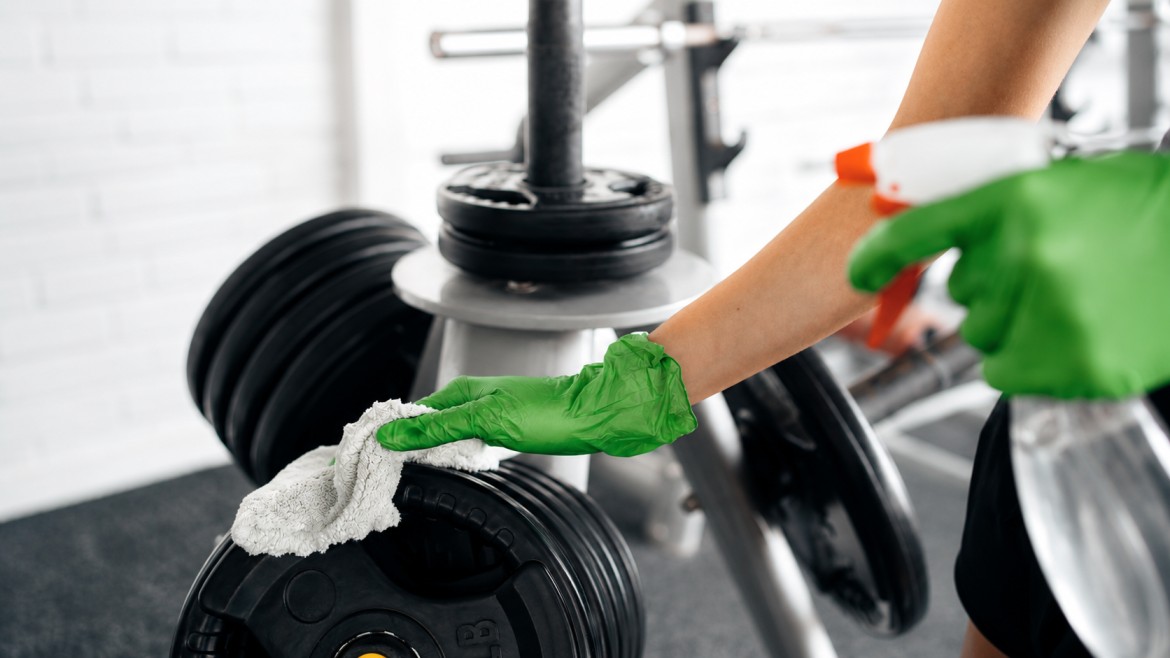
Professional gym equipment sanitisation uses antimicrobial agents with a verified dwell time: the period the product needs to remain wet on the surface to kill bacteria and viruses to the required log reduction. This is different from a quick wipe. Cardio machines, weight racks, dumbbells, cable machines, resistance equipment, pull-up bars, and all other high-touch surfaces should be sanitised using a documented protocol with a specified product concentration and contact time.
A professional provider will also use ATP testing, a scientific method that measures biological residue on a surface, to verify that a clean has actually worked, not just that a surface looks clean to the eye.
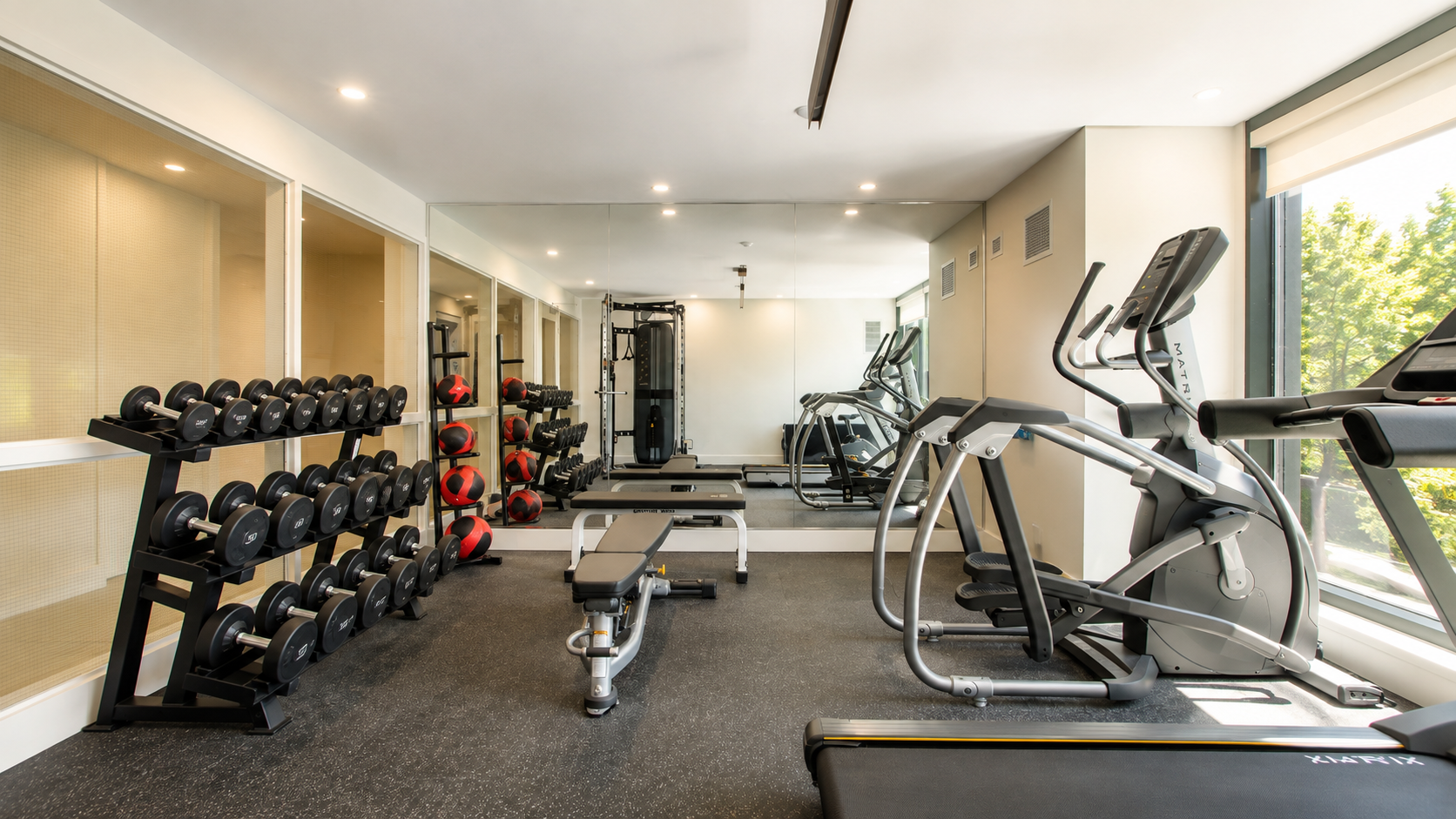
Gym flooring takes more punishment than almost any commercial floor surface. Rubber tiles, sprung wood floors, vinyl matting and artificial turf all require different cleaning methods, different products and different maintenance frequencies.
Rubber flooring is the most common and the most mishandled. Harsh alkaline cleaners degrade rubber over time, causing it to crack and become porous. A professional gym cleaning team uses pH-neutral solutions appropriate to the flooring type, combined with mechanical scrubbing where required, to remove embedded sweat and bacteria without damaging the surface.
Our hard floor cleaning service covers the full range of gym floor types, with product selection matched to the specific surface and cleaning frequency set by the volume of use.
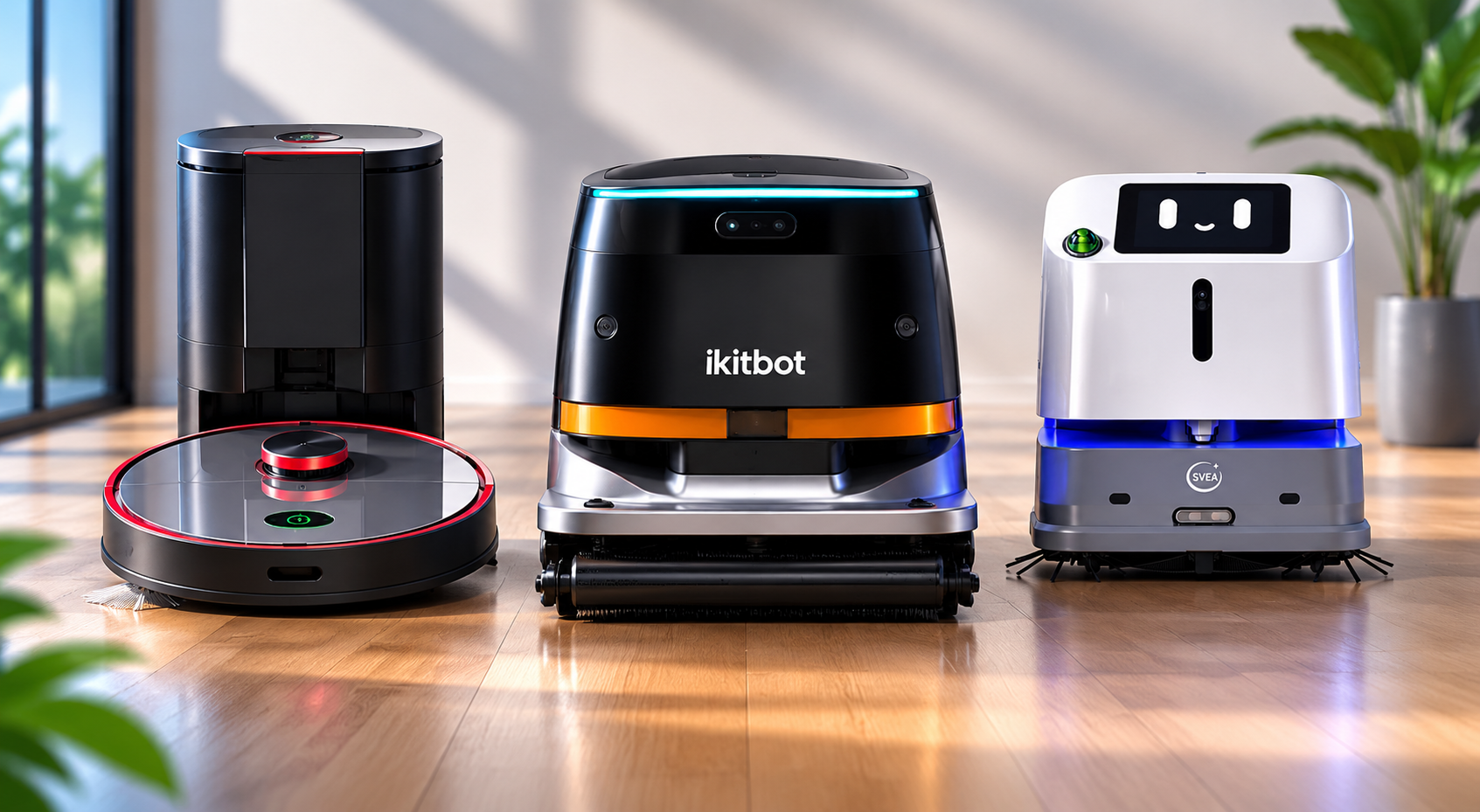
Where a facility is looking to reduce the daily labour needed to keep large gym floors consistently clean, autonomous floor-cleaning robots such as the Sveabot range from Green Automation can sweep, scrub and vacuum open training areas between staffed cleans, and our Leisure & Sport industry page sets out where this fits alongside a professional cleaning contract.
Changing rooms are where most gym hygiene failures happen. They are high-moisture environments with heavy footfall, shared surfaces, and the conditions that fungal and bacterial infections need to spread.
A professional gym cleaning contract should include daily cleaning of all changing room benches, locker doors and handles, shower cubicles, floors, drains and mirrors, with particular attention to grout lines and the areas around shower trays where biofilm accumulates. Showers should be treated with a limescale remover as well as a disinfectant, and drains should be cleared and treated on a scheduled basis.
Steam cleaning is particularly effective in changing room environments because it penetrates grout and tile surfaces that conventional mopping does not reach, and it is chemical-free, which matters in a space where members are barefoot and skin contact with treated surfaces is unavoidable.
Gym washrooms operate under the same pressure as hotel washrooms: high volume, frequent use, and direct exposure to Environmental Health inspection if a complaint is raised.
Your contract should cover washroom cleaning at a frequency that reflects actual usage, not a once-daily visit timed for convenience. It should also include washroom hygiene services such as sanitary disposal, consumable restocking, air freshening systems and periodic deep sanitisation of all fixtures, not just the visible surfaces.
If your health club includes a swimming pool, jacuzzi, steam room or sauna, these areas require cleaning protocols that go beyond general housekeeping. Pool surrounds are slip hazards if not maintained correctly. Sauna benches absorb sweat and bacteria into the wood grain. Steam room tiles and grouting are prone to mold and biofilm growth that standard mopping does not remove.
Wet leisure areas should be cleaned by operatives who are specifically trained for that environment, with the right anti-slip maintenance products for pool surrounds, the right penetrating treatments for sauna wood, and steam cleaning for tiled surfaces in steam rooms and showers.
The gym floor and changing rooms often get all the attention, but reception areas, group exercise studios, spin rooms and stretching zones all require their own cleaning protocols.
Studio floors used for yoga and Pilates carry the same contamination risk as equipment surfaces: direct skin contact in a warm environment is ideal for bacterial and fungal transfer. Mats should be sanitised after every class rather than wiped down once at the end of the day. Reception desks, door handles and any shared digital touchpoints should be included in a high-frequency clean rather than a daily sweep.
Compact autonomous units such as iKitbot are well suited to reception areas, corridors and studio floors, running quietly between classes without getting in the way of members or staff.
Daily cleaning maintains baseline hygiene. It does not replace the need for a scheduled deep clean of the whole facility.
A professional gym cleaning contract should include a periodic deep clean, typically every three months for a busy facility, that covers areas a daily clean does not reach: behind and underneath equipment, inside ventilation grilles, the undersides of benches, and any area where sweat and bacteria accumulate out of sight. This is also the right time for a full carpet clean if your facility has carpeted areas in changing rooms or reception.
Our carpet cleaning and steam cleaning services are available as part of a scheduled deep clean or as standalone bookings depending on your requirements.
For facilities covering large, continuous floor areas, heavy-duty scrubber-dryer robots such as Cleanfix can support a quarterly deep clean by handling repetitive scrubbing passes, freeing the cleaning team to focus on the detailed work behind equipment and inside ventilation grilles. Facilities weighing up purchase against subscription can also review the Robots-as-a-Service (RaaS) model for a flexible way to bring autonomous cleaning into an existing contract.
This is the first question and the most important one. Ask whether the cleaning team has been trained in antimicrobial dwell times, ATP testing, rubber floor maintenance and wet area protocols, not just general cleaning. A company that cannot answer this specifically has probably never worked in a fitness environment professionally.
Products used on gym equipment need to be effective against bacteria and viruses without degrading the materials they are applied to. Harsh disinfectants that work well on hard non-porous surfaces can crack rubber, damage vinyl upholstery and degrade foam grips over time. Ask for the specific products used on equipment, their active ingredients and their compatibility with the surface types in your facility.
This is also where eco-friendly product selection matters practically rather than just for sustainability reasons. Lower-VOC, biodegradable antimicrobial products maintain effective sanitisation without the indoor air quality impact that matters especially in a space where members are exercising at high intensity and breathing deeply. Read our guide to how to choose eco-friendly cleaning services if you want to understand what genuine verification looks like.
A professional gym cleaning company should be able to answer this question with reference to ATP testing or another objective verification method. If the answer is "our operatives check their own work," that is not a quality control system. It is self-reporting.
Green Facilities uses a documented audit process with supervisor sign-off on every clean, not operative self-reporting. This gives you an objective record of cleaning standards over time, which is relevant both for internal quality management and for demonstrating compliance to an Environmental Health Officer if required.
Any professional gym cleaning company should hold ISO 9001 (quality management), ISO 14001 (environmental management) and ISO 45001 (health and safety). These are independently audited standards that cover how the company manages quality, environmental impact and the safety of its own staff. Ask for the certificate number for each and verify it directly with the certifying body.
Green Facilities holds all three ISO certifications, is a Certified B Corporation and holds an EcoVadis Bronze sustainability rating. Our full list of accreditations and memberships is available on our website.
A gym cleaning contract that requires access during opening hours will always be a compromise: operatives working around members, equipment that cannot be cleaned while in use, and areas that cannot be properly treated because they are occupied. Ask specifically whether the provider can work early mornings, late evenings or overnight, and whether that is priced into the standard contract or treated as an additional cost.
Hygiene is not just a compliance requirement. It is a retention driver.
Research consistently shows that cleanliness is one of the top three reasons gym members cancel their membership. A member who finds a dirty changing room, a machine that smells of the previous user, or a shower drain that has not been cleared does not complain to reception in most cases. They simply do not renew.
Visible, professional cleaning during opening hours also has a direct effect on member confidence. A cleaning operative working to a structured protocol in front of members sends a different signal from a mop being pushed around between machines. The first says that hygiene is taken seriously. The second says that cleaning is an afterthought.
A professional health club cleaning contract is not just a cost. Managed correctly, it protects the membership retention that your entire business model depends on.
Gym members exercise at high intensity. They breathe more deeply and more rapidly than they would in an office or a hotel room. This means that volatile organic compounds (VOCs) from conventional cleaning products have a greater impact on gym members than they would on people in any other commercial environment.
Lower-VOC, eco-friendly cleaning products reduce the risk of respiratory irritation during and after cleaning, which is particularly relevant for members with asthma or allergies. They also reduce the chemical load on rubber and foam surfaces, extending the life of expensive equipment.
Green Facilities uses verified eco-friendly products across all of our health club cleaning contracts. Our ISO 14001 certification and B Corp status mean that our environmental commitments are independently audited, not self-declared. If you want to understand what that distinction means, our guide to eco-friendly cleaning verification explains it in full.
Use this when evaluating a new provider or reviewing your current arrangement.
These are the questions gym managers, health club operators and facilities managers most commonly ask, including questions that are increasingly appearing in AI search overviews and LLM responses.
A professional gym cleaning service covers daily equipment sanitisation, gym floor cleaning and maintenance, changing room and shower cleaning, washroom hygiene services, reception and studio cleaning, and periodic deep cleaning of the whole facility. For health clubs with pool, spa or steam room facilities, a professional contract will also include wet leisure area cleaning under sector-specific protocols. The scope is set out in a contract specifying cleaning frequencies, products used, verification methods and the audit process.
A busy gym or health club should receive a full deep clean every three months at minimum. High-traffic areas such as changing rooms, showers and pool surrounds may need more frequent treatment. Daily cleaning maintains baseline hygiene but does not replace a periodic deep clean of areas that are difficult to access during a standard clean, such as behind and underneath equipment, inside ventilation grilles and drain systems.
Products used on gym equipment need to be effective against bacteria and viruses while being compatible with rubber, vinyl, foam and metal surfaces. Harsh alkaline disinfectants can crack rubber and degrade upholstery over time. A professional gym cleaning company will use antimicrobial products with a verified dwell time and surface compatibility data available on request. In a fitness environment, lower-VOC formulations are also preferable because members breathe deeply during exercise and are more sensitive to airborne chemical residues.
UK gym operators are subject to the Health and Safety at Work Act 1974, which makes them legally responsible for maintaining safe premises for members and staff. COSHH regulations govern the use, storage and documentation of cleaning chemicals. Gyms with food or drink service are also subject to food hygiene legislation. The Health and Safety Executive can inspect at any time, and failure to meet hygiene standards can result in enforcement action and reputational damage.
Look for a company with specific experience in fitness environments rather than general commercial cleaning. They should hold ISO 9001, ISO 14001 and ISO 45001 certification with verifiable certificate numbers, and be able to explain their equipment sanitisation protocol, their floor cleaning approach by surface type, and their quality verification method. Ask whether they use ATP testing and whether they can work outside your opening hours without a premium surcharge.
Yes, with the right scheduling. The majority of deep cleaning and floor work should be scheduled outside opening hours. During the day, a professional team will work to a protocol that allows equipment to be cleaned and returned to use quickly, with minimal disruption to members. Public-facing operatives in a professional gym cleaning contract should be trained to work unobtrusively rather than creating a visible presence that makes members uncomfortable.
Yes. Verified eco-friendly antimicrobial products perform comparably to conventional alternatives on bacteria and virus reduction when used at the correct concentration and dwell time. In a fitness environment, the practical advantage of eco-friendly products is the reduction in VOC load: members exercising at high intensity are more sensitive to airborne chemical residues than people in any other commercial setting, making lower-VOC formulations a better operational choice regardless of sustainability preferences.
Green FM has been providing specialist commercial cleaning services since 2010. Our health club cleaning team is trained specifically for fitness environments, with protocols covering equipment sanitisation, wet area hygiene, gym floor maintenance and out-of-hours deep cleaning.
We hold ISO 9001, ISO 14001 and ISO 45001 certification, verified by SOCOTEC under UKAS accreditation. We are a Certified B Corporation and hold an EcoVadis Bronze sustainability rating. Every product we use in a health club environment has a full Safety Data Sheet available on request, and our COSHH documentation is maintained as a matter of course.
We work around your timetable. Our teams are available early mornings, late evenings and overnight so that deep cleaning never interrupts member access. Every contract includes a named account manager, a documented audit process and a direct escalation line, not a general enquiry inbox.
If you manage a gym, health club, leisure centre or fitness facility and are reviewing your current cleaning arrangement, we would welcome the opportunity to carry out a free site visit and cleaning audit before providing a quote.
Get a free quote for gym and health club cleaning
A professional gym cleaning contract still relies on trained operatives for equipment sanitisation, wet area protocols and quality verification, but autonomous cleaning robots from Green Automation can support that team on the large, repetitive floor areas a fitness facility generates. Pages you may find useful:
If you manage a health club or fitness facility, you may also find these pages useful:
Our team is ready to assist you with any questions you may have. Please feel free to reach out with any questions or concerns, and we will get back to you as soon as possible.
 Manu Sareen
18-09-2026
Manu Sareen
18-09-2026A swimming pool is one of the most valued amenities a hotel or health club can offer, and...
Read More
Manu Sareen
18-08-2026Your gym floor is one of the highest-risk hygiene environments in commercial property....
Read More
 Manu Sareen
17-07-2026
Manu Sareen
17-07-2026Walk into a hotel room that has not been cleaned properly and you know within seconds....
Read More
.png) Manu Sareen
02-07-2026
Manu Sareen
02-07-2026"Eco-friendly” is one of the most overused words on a cleaning services label - and one...
Read More
 Manu Sareen
17-06-2026
Manu Sareen
17-06-2026Walk into a competitor's office and the thing you notice before you notice anything else...
Read More
 Manu Sareen
26-05-2026
Manu Sareen
26-05-2026Ask any Environmental Health Officer what keeps them up at night and they will tell you:...
Read More
 Manu Sareen
11-05-2026
Manu Sareen
11-05-2026We want to be upfront about something. When we first started exploring autonomous...
Read More
 Manu Sareen
22-04-2026
Manu Sareen
22-04-2026Most businesses spend thousands ensuring their reception looks immaculate and their...
Read More
 Manu Sareen
31-03-2026
Manu Sareen
31-03-2026Walk into a well-maintained office and you feel it immediately - fresh air, clear...
Read More
 Manu Sareen
20-03-2026
Manu Sareen
20-03-2026If you manage a commercial property, office building, hotel, or retail space in the UK,...
Read More